
角位置传感器 IC
Allegro 的 2D 角度传感器可提供模拟和超低延迟(~10 µs)的数字输出,以实现汽车、工业和机器人应用中的精确电机控制。我们的传感器符合 ASIL-D 标准、支持双芯片冗余以及低至 ±0.3° 的角度精度,可确保平稳、高效和可靠的运行。
Featured Products
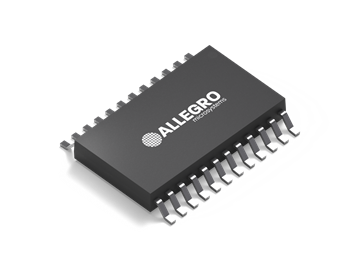
A33020
The A33020 is a stray field immune, 360° angle sensor IC that provides high-resolution angular position information based on magnetic sensing technology.

A33110
Precision TMR Angle Sensor with Integrated Diagnostics
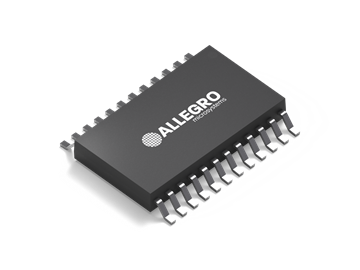
AAS33001
Precision Angle Sensor IC with Incremental and Motor Commutation Outputs and On-Chip Linearization

CT310
The CT310 is a 2D angular sensor in a dual full-bridge configuration.
Documentation & Resources

Application Note
Microcontroller-Based Linearization of Angular Sensor ICs
AN296160 - Magnetic angle sensors are often a good choice for fast, reliable, contactless measurement of the angular position of a system, especially in dirty environments where optical encoders may not be a good fit.
Application Note
Advanced On-Chip Linearization in the A1335 Angle Sensor IC
AN296127 - This document shows how magnetic-input-related errors in excess of ±20 degrees can be linearized by the A1335 to as low as ±0.3 degrees—roughly a 65× improvement.

Brochure
Brochure: Motor Position and Angle Sensing
The Allegro A33230 Hall-effect position and angle sensor IC is the smallest 3D Sine/Cosine sensor currently available in the market.
Application Note
Output Protocols for Angle and Linear Position Sensors
AN296191 - This application note describes working principles, lists advantages and limitations, outlines communication rates/delays, and defines error reporting tactics for digital and analog protocols used in angle and linear position sensing.
Application Note
A1337/A1338 System Timing
AN296138 - The A1337 and A1338 are high-speed high-accuracy magnetic angle sensor ICs, ideal for motor position sensing. This application note provides a brief description of the internal signal processing delays of the A1337 and A1338 angle sensors.

Technical Article
How Hardware Selection Impacts Driver Experience in EPS Systems
P0234: Electric power steering systems have become popular in automotive manufacturing, displacing their mechanical counterparts because they save space, weight, emissions, and reduce fit complexity.