
How Speed Sensors are Making Two-Wheelers Smarter and Safer
Two-wheelers have established themselves as a fundamental means of transportation throughout the world, being a lower-cost and smaller alternative to the automobile while maintaining freedom and independence compared to public transportation.
For decades, gas-powered motorcycles and scooters have served as the backbone of personal mobility in many parts of the world, and now electric motorcycles and scooters are emerging as clean, quiet, and efficient replacements. In the lightest weight segment of them all, e-bikes merge the age-old bicycle with advanced motor control, to create a minimalist motorized solution for both commuting and recreation.
New systems focus more-and-more on safety, reliability, and ride experience, and one type of sensor integrated circuit (IC) helps achieve these goals: the magnetic speed sensor. By detecting the rotation of gears and wheels with exceptional precision, they provide essential data for two-wheeler control systems. From enabling life-saving Anti-lock Braking Systems (ABS) to optimizing engine performance, speed sensors serve important roles. Allegro designs these advanced ICs to handle the harsh realities of the road using internal signal processing to compensate for vibration, temperature changes, and installation tolerances to provide a clean electrical output. This paper explores the vital roles of these sensors across three key segments of the two-wheeler market.
Gas-Powered Motorcycles and Scooters
The internal combustion engine has been at the heart of motorcycles and scooters since their inception, and while the core mechanics remain, the systems controlling them have become increasingly sophisticated. Magnetic speed sensors have allowed for enhanced safety, greater efficiency, and reduced emissions.
One important application is crankshaft sensing, where the speed sensor provides the engine control unit (ECU) with the precise rotational speed and position of the crankshaft. This data is used for fuel injection timing and ignition. While cruder bike designs have historically used simple reluctance sensors than cannot sense below around 200 RPM, more advanced bikes use speed sensors. Allegro’s A1694 and A1696 deliver accurate speed and direction information down to zero-speed, a capability that helps control fuel injection and ignition timing, which is especially important at cold temperatures where fuel and air do not mix as effectively. Without such low-speed sensing and control, engines can misfire or fail to start. Allegro also offers the ATS694, which has the back-bias magnet fully integrated with the semiconductor package for maximum reliability, design-in ease, and fastest time to market. For top performance, the A1696 possesses Allegro’s most advanced crankshaft algorithms and delivers the lowest jitter for exceptionally stable engine timing.
In two-wheeler transmissions, speed sensors measure rotation to ensure smooth gear changes and operation within the max acceptable RPM. For this, the A1468 and ATS468 are field-proven and frequently used. By employing robust differential sensing, these ICs achieve superior air gaps compared to single-ended sensors, while not requiring any end-of-line programming of thresholds, making them the best-suited sensors for the job.
Perhaps the most significant impact of speed sensors in two-wheelers is in safety systems. Wheel speed sensors establish the foundation of Anti-lock Braking Systems (ABS) and traction control. ABS prevents wheel lock-up during hard braking, a common cause of crashes that can lead to a loss of control or the bike flipping over. With the new mandate in India requiring ABS on all new two-wheelers starting in 2026 (at the same time as requiring each bike to be sold with two helmets), this technology is moving from a premium feature to a minimum safety standard. For this safety-critical function, the A19200 and ATS682 actively measure wheel rotation, providing the quickly-updated data the ABS module needs to control wheel braking. While front-wheel sensing for ABS is most important to prevent flip-over accidents, rear-wheel sensing enables Traction Control Systems (TCS) to prevent spin-outs that would cause bikes to turn to the side. Premium bikes sense both wheels.
Finally, for speedometer and odometer functions, Allegro offers a family of robust sensors including the A1422, A1425 (3-wire), and A17201 (2-wire), which use differential AC-coupled architectures that inherently ignore thermal drift and other disturbances to provide accurate speed information to the rider.
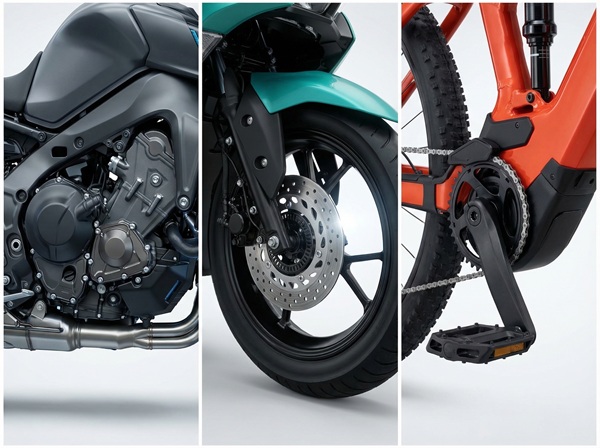
Electric Motorcycles and Scooters
With electric motorcycles and scooters, there is no engine crankshaft or transmission to be sensed, but the wheels, speedometer, and odometer functions remain. The instant power of an electric motor makes ABS and TCS arguably even more important than on gas-powered bikes. And instead of measuring engine size in cubic centimeters (cc), electric bike motor sizes are measured in kilowatts (kW); the venerable 125 cc gas engine loosely translates to around 7 kW for an electric bike.
Wheel sensing is a cornerstone application in electric two-wheelers. The A19200 and ATS682 are once again key solutions, providing the precise wheel speed data for effective ABS and TCS.
For accurate speed and odometer measurement, the A1422, A1425 (3-wire), and A17201 (2-wire) likewise remain excellent solutions, offering designers flexibility for various wiring harness configurations. This sensor data is also used to calculate remaining battery range.
While most two wheeler systems today are not designed to the ISO 26262 functional safety standard that is popular in the automotive space, Allegro offers a comprehensive portfolio of ASIL-rated ICs that are ready to meet this need when two-wheelers adopt it.
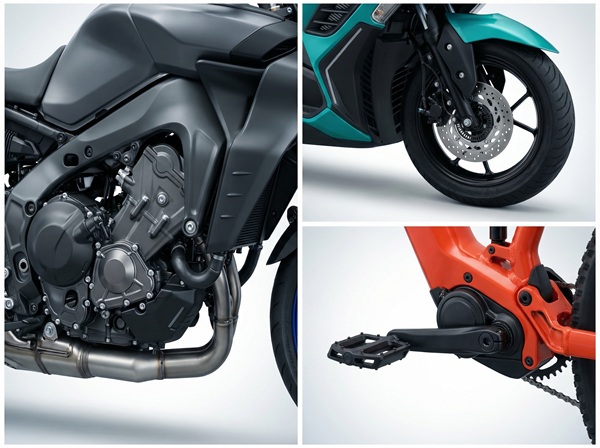
E-Bikes
The e-bike segment is one of the fastest-growing areas of personal mobility, blending the simplicity of a bicycle with electric motor propulsion.
The central human input for an e-bike is the Pedal Assist System, which engages motor assistance as the rider pedals. Pedal input is normally sensed in one of two ways: by applied torque (found in more premium models), or simply by the rotation of the crank arm (referred to as “cadence sensing”). While some e-bikes measure cadence using optical incremental encoding, that can have reliability downfalls, as those can be prone to failing from contamination or mechanical misalignment blocking the light. In contrast, speed sensors like the A1605 and ATS605 offer a significantly more robust solution. These Hall-effect ICs employ differential magnetic sensing and provide two outputs that convey speed and direction, so the motor knows when to engage, and when to disengage when pedaling stops or reverses. And if ISO 26262 functional safety is needed, Allegro also offers the similar A17501 and ATS17501. For designs seeking maximal mechanical flexibility with minimal maintenance required, the ATS19580 GMR sensor is unmatched in its large air gap capability and vibration detection, whether it is used to measure cadence or the wheels.
As e-bikes become faster and more powerful, accurate wheel speed sensing is increasingly valuable. In addition to the speedometer and odometer functions, wheel sensing also enables ABS to prevent wheel lock-up and flip-over accidents. Popular choices include the 2-wire A19200 and ATS682, the 3-wire ATS468, and the 2-wire GMR-based ATS19480 which offers large air gap sensing for maximum tolerance.
Conclusion: Essential Technology
From crucial engine timing in a high-performance motorcycle, to high-speed transmission measurement, to life-saving intervention during ABS braking, to reliable e-bike system measurements, magnetic speed sensors are an indispensable part of the technology that comprises modern two-wheelers. As the industry continues to evolve toward greater safety and electrification, the need for reliable and intelligent sensing will grow. Allegro’s world-class portfolio of sensors, regulators, and drivers, backed by expert design-in support, is enabling the creation of new smarter and safer two-wheelers.